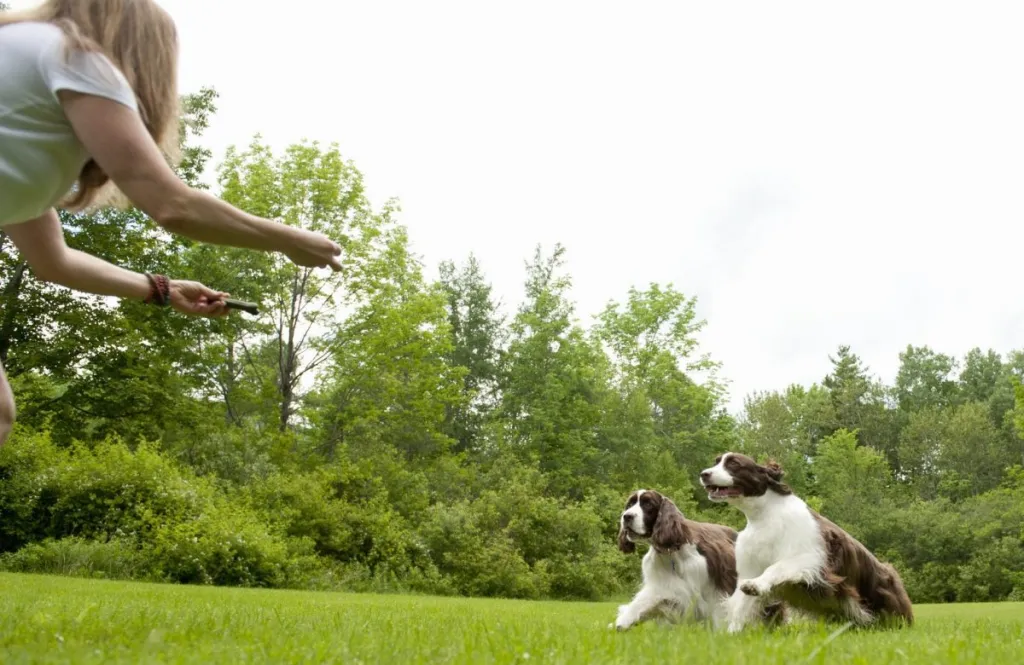
There is nothing more frustrating than trying to chase a dog that plays “keep away” when you are trying to get them to come. Here are a few tips on improving your dog’s recall.
Real world vs. show ring
In the show ring, the dogs sit quietly, totally intent on watching their handler, then fly back toward them when they hear the word “come.” They then sit beautifully straight in front of their handler and even swing around to heel position when asked to do so.
These perfect “recalls” rarely exist in real life, even when a show dog is called outside of the show ring. Why? First of all, the conditions are rarely the same. When we are recalling our dogs in the real world, they are usually busy doing something else they find interesting — not waiting patiently for our command.
Tips to improve your dog’s recall
Your dog can learn to come when called, but it’s a joint effort on both your part and the part of your dog. Here are some rules to remember as you train your pup to come.
Consider what “come” means to your dog
First, consider what the word “come” means to your dog. Have you asked them to come when you are going to do something unpleasant to them, such as clean their ears or poke a pill down their throat? We have all done this, but unfortunately, this is one reason that some dogs hesitate before coming when called, and sometimes will not come at all.
Your “come” command should always mean something wonderful is about to happen. If your dog has already decided that coming is optional, why not change the word you use? “Here” is a solid alternative.
Change your tone
Always call your dog in an upbeat tone of voice, even when you are panicked because they are darting away into a dangerous road. If you yell like you’re furious, your dog may be afraid to come to you. If you keep your tone high and upbeat, your dog is more likely to choose coming over running away.
Know what you’re up against
Manage the circumstances. If your dog is in a position where they are very unlikely to come when called, such as off-leash playing with the next-door neighbor’s dog, do not even call them. Your dog doesn’t need more practice ignoring the recall command. In this case, simply go to your dog, take their collar, and snap their leash to it.
Many dogs, such as Beagles, can become so intent on sniffing something that they will not even hear you if called in their own backyard. If you can tell your dog is on an “intense sniff,” simply walk over to them as opposed to calling them. Until your dog has proven that they can respond to your command reliably, they should not be expected to come off-leash.
Recall training on a leash
How do you train your dog to come reliably? Start by walking your dog on their regular leash. Let them get a little bit ahead of you, then say “Fluffy, here!” in your most cheerful voice. Then, move backward, away from them. If necessary, you can hold a treat at their nose level as a lure to pull them towards you (if they will come without the food treat, then don’t use it).
When they are just a step or two away from you, pull the treat upwards if you wish to lure them into a sit in front of you. Or simply praise and pet. Then, take off walking again, repeating this several times during each walk.
After your dog is doing this reliably on a standard 6-foot leash, then change to a longer leash, such as a 15-foot cotton web long line. Let your dog get further away before you call them. As they become reliable with distance, you can progress even to a 30-foot leash, and add distractions by having someone bounce a ball or hold another dog on leash nearby.
You can also go to an open area and let your dog play without holding the long line, just let them drag it so they feel as if they are off-leash, then call them. If they don’t come, pick up the leash, take up the slack, and give a quick collar correction. Run backward while clapping your hands if needed to encourage them from further away.
Be sure to know what your dog likes best. If it is a squeaky toy or tennis ball, then incorporate these as rewards, instead of depending on just treats and/or praise.
Come and get it
Another easy exercise to instill a positive response to a “here” command is the “come and get it” game. Play this in a confined area, such as your kitchen or hallway.
Show your dog a treat, then say “get it” and toss it a couple of feet away. As they take the treat, say “good” and then quickly say “here!” Show them that you have another treat, which you give your dog as soon as they arrive.
Repeat several times in one session, and do several of these sessions a day the first week. The following week, play the two-person recall game. Each person has small treats, about the size of a Cheerio. One person holds the dog by the collar, while the other person gives the “Fluffy, here!” command, luring the dog in with a treat. Then they hold the collar while you give the command. Quickly change to variable reinforcement, varying the types of treats you are giving and not giving the treat each time, so the dog never knows what is coming.
Hide and seek
Dogs trained with these simple exercises quickly can go to playing “hide and seek” in the house. This is where you go around the corner and call them when you are out of sight, rewarding them when they arrive. Eventually, you can go into another room and call them. This type of recall practice is very practical, as you may not always be in the dog’s line of sight when you need to call them when you’re out and about.
Final thoughts on dog recall
Make sure that neither you nor any children in the dog’s life play chase games with the dog. Dogs who are allowed to play “catch me if you can” will certainly be the hardest ones to convince that a “come” or “here” command should be heeded.
Also, make sure that your bond with your dog is strong, and reward your dog with a smile and praise anytime they look your way, even if you have not called them. Your relationship with your dog will be a strong factor in whether or not you will be able to get them to come when called off-leash.
Keep in mind that certain dogs have the instinct to run in their genetic makeup, so keeping them on a leash is imperative. Many of these dogs have a high prey drive, meaning they will chase (and sometimes even kill) small animals. With these dogs, you must limit off-leash exercise to a securely fenced area.
One tip to getting these dogs to come within a fenced area is to mimic the noise and actions of “prey.” Some toys, when squeezed, make a high-pitched squealing noise that sounds almost like a bunny in distress. If you squeeze this type of toy, then run away from your dog, the dog’s chase instinct may kick in and they will bring it to you.
Repetition is key
Remember that it takes nearly a month to condition a behavior to the point of an automatic response. In order for your dog to start coming automatically, even in the presence of distractions, you need to practice positive recall exercises such as those above for a period of about four consecutive weeks.
If you follow the steps above and positively reinforce your dog when they come to you, then it should eventually become an ingrained habit for your dog to come running when they hear the word “here.” This type of response takes some work on your part, but it is well worth it. A reliable recall could someday save your dog’s life.