While many of us are trained on cardiopulmonary resuscitation (CPR) procedure for humans, when it comes to animals–particularly our dogs–many of us may not know what to do. If there were a medical emergency, would you be ready to give your dog CPR?
For those unfamiliar, CPR is an emergency medical procedure used for those suffering cardiac or respiratory arrest–those whose heart or breathing have stopped. It serves the same function in dogs as humans. If your dog is not breathing or is in cardiac arrest, those are medical emergencies that could require dog CPR.
Here is everything you need to know about CPR for dogs: when to use it, how to administer it, and what to do if your dog is not responding to the procedure.
How CPR Helps Your Dog
CPR serves the same function in humans as it does your pup. If your dog is unresponsive, not breathing, or in cardiac arrest, CPR provides artificial respiration and blood circulation. In other words, you are doing the work that your dog’s heart and lungs normally do automatically.
The chest compressions administered during CPR helps manually circulate blood. The breaths keep oxygen flowing in your pup’s system. Combined, the compressions and ventilation can help keep these vital life processes going until your dog is breathing on their own with a regular heartbeat.
How To Tell If You Should Perform CPR
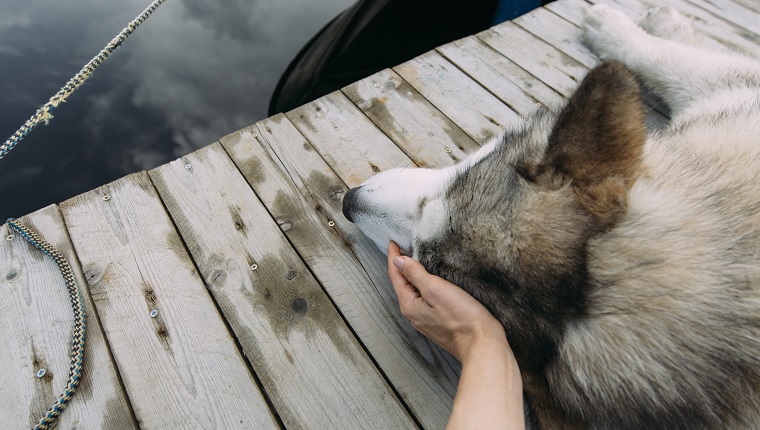
You’ll need to perform CPR if your dog has no pulse, but how do you determine that?
First, you need to check for vital signs. Check for breathing by looking for a rising and falling chest, then place a hand close to the snout to see if you can feel breath. You can also examine your dog’s gums; if they are blue or gray, this means oxygen is not circulating through your dog’s system.
You should also check for a pulse. The femoral artery–or the big vein towards on the inside of your dog’s hind leg–is the best place to check. Feel for a pulse on the upper end of your dog’s hind leg.
For many owners, the most common reason they will need to perform dog CPR is that their dog is choking.
For Puppies And Dogs Under 30 Pounds:
1. Lay the dog on their right side.
2. Locate your dog’s heart. The heart can be found just behind the points on the front elbows, in the chest. Place a cupped hand over the heart on either side of the chest (one hand resting between their body and the floor) and compress one to one-and-a-half inches. Count to one, then release for one count. Continue at a rate of 100 compressions per minute. To help you count, you can always perform compressions to the beat of “Stayin’ Alive” by the Bee Gees – a song popularly used in medical training, as it has 103 beats per minute.
3. If there’s someone to help you perform CPR, provide one breath using mouth-to-nose breathing every two to three compressions. If you’re alone, provide one breath every five compressions.
4. FOR PUPPIES: Use your thumb on one side of the puppy’s chest, with your fingers on the pup’s other side. Less force is required when performing CPR on puppies, but be sure your actions are strong enough to compress the chest.
For Dogs Over 30 Pounds:
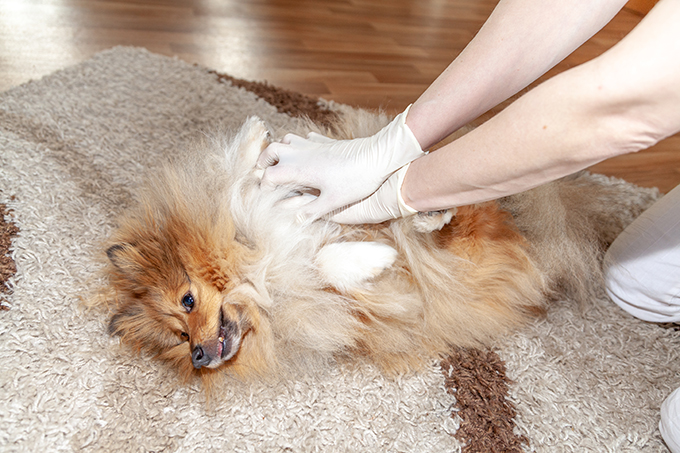
1. Perform the steps above, but use both hands on the same side of the chest. Don’t place your hand directly over the heart. Instead, kneel behind the dog’s back, place the heel of your hand at the widest portion of the rib cage, and place your other hand on top of the first hand.
2. Keep your elbows straight. Push straight down, compressing the chest two to three inches, at a rate of one-and-a-half to two times per second. This is around 120 beats per minute. If you are looking for a song to follow, “Achy Breaky Heart” by Billy Ray Cyrus hits that tempo.
3. If there’s someone helping you perform CPR, provide one nose-to-mouth breath every two to three compressions. If you’re alone, provide one breath every five compressions.
You must continue CPR until the dog has a steady pulse and is breathing on their own. If you are still unsure of how to perform CPR on your dog, you can watch the video above.
What To Do Once Your Dog Responds To CPR
If your dog regains consciousness after you perform CPR and is breathing on their own, go to your emergency vet immediately. You want to make sure whatever caused your dog to be unresponsive is truly taken care of. Also, ribs can crack during CPR, so it is important to make sure your dog doesn’t have fractured ribs or any other injuries from the procedure.
What To Do If Your Dog Does Not Respond To CPR
Ideally, someone should be contacting your emergency vet while you perform CPR on your dog. A medical professional will be able to better assess the situation and tell you how to proceed with your CPR efforts.
Unfortunately, it is unlikely that a dog who does not respond to CPR in the first ten minutes can be saved. If your dog is not revived, talk to your vet to see what options you have available.