Animal behavior: Like baby, like dog

Friday February 10th, 2012

  • Share on Facebook
Max_300_animal-behavior-baby
A study from Budapest explains why we talk to our dogs as if they were babies.

Anyone who has ever loved a dog might be interested in a new study out of Budapest that sheds light on why we talk to our dogs as if they were babies. Researchers at the Hungarian Academy of Sciences are reporting that a dog’s communicative skills are, in fact, much like that of a 6-month-old baby. The study’s results “support the notion that dogs are sensitive to the cues of signaling humans’ communicative intent in a way that is analogous to preverbal human infants,” said the author, Josef Topel, an associate professor in the Comparative Behavior Research Group at the Institute for Psychological Research.
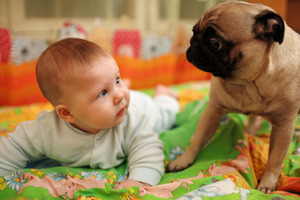
The research seems to confirm what we already know intuitively: that dogs, and babies, understand and anticipate their owner’s (their parent’s) intentions mostly through nonverbal communication—like eye contact and body language––although the pitch of our voice is important—as it is to a baby.

The study “Dogs' Gaze Following Is Tuned to Human Communicative Signals," in the January 5, 2012 issue of Current Biology was simple enough. Researchers showed 16 dogs two different videos. In the first video, a woman looks at a dog and says, “hi dog,” in a high- pitched voice. Using an eye-tracking technique, the same used to check the development of a baby, the woman then turns towards a plastic pot sitting on an adjacent table. In the second video, the woman avoids eye contact with the dog, and says “hi dog” in a lower pitch, and then looks at the plastic pot on the table. It’s not surprising that the dogs that made eye-to-eye contact, and were addressed in a high-pitched voice, were more likely to follow the woman’s eyes to the plastic pot, as if able to read her intent. This is the kind of skill you would expect to see in a 6-month-old child, according to the report.

Researchers are hopeful that the same eye-tracking method used in this experiment will also be useful in others that measure a dog’s cognitive processing, like its memory and ability to reason. Meanwhile, this study is important, according to Adam Goldfarb, director of pet care issues at the Humane Society of the United States,because it reminds us just how communicative our canines and humans can be. “This should reinforce that if we want our dog’s attention, we should be clear about it,” he said.

“Those people who talk to their dog in a baby-talk voice, they should keep it up," he said. "Your dog will pay more attention.”
More dog Content
  • Square_100_black_dog

    March 31st, 2011

    This article courtesy of woofreport.com. Does your dog gaze at you intently while youre eating, his eyes locked on you like nothing else matters in the world? He doesnt want your food, hes memorizing...

  • May 7th, 2009

    Researchers at The Pine Street Foundation, a research center in San Anselmo, California, have discovered that dogs have the ability to detect cancerous tumors earlier and more...

  • Square_100_dog_tail

    March 31st, 2011

    This article courtesy of woofreport.com. We all know non-verbal communication is key in how dogs communicate their feelings and general state of mind. We can observe whether a dog is relaxed, fearful,...

No comments about this page yet. Be the first!

Recent conversations on these topics

  • I'm being "shunned" by my dog

    My Basenji puppy is acting very fearful around me. He has even bit me aggressively. I have tried to give him love affection and positive reinforcement, with treat and praise but he still try's to avoid me. What am I doing wrong?

  • Dog Sharing ?

    I have recently found out about dog sharing, where people who can't cope through illness or infirmity or because they are suddenly working away or for whatever reason are finding it hard not to neglect their dog and wonder what to do about it. So dog sharing is where you share the care of your dog with someone else in the local community. It could be anything from occassional walks to a second home and anything in between. I found a website that facilitates it at http://dog.findashare.com but I am getting second thoughts now. Is it good for the dog as well as the owner, and if not, what are the alternatives if you just can't cope full time like you used to? I am having a real dilema about what's best and if this is a good or a bad thing. My trouble is I can see both sides of the coin equally!

  • Aggressive Pomeranian

    Cesar, I have 3 lap dogs that I got as puppies. 8 year old papillon that is 8 lbs, 6 year old papillon that is 16lbs and a 2yr old pomeranian that is 8lbs. in the last few months the pomeranian has started attacking the 8 yr old papillon and the the 6yr old papillon joins in which she has never done anything like that before. The 8yr old pap is about to get her teeth cleaned and I have noticed the pom has been getting right in her face and sniffing which makes the pap growl and there it starts. I have been attaching the pom to me via a leash when I first get home as it seems to happen most often then and when it is just me, my husband is not home. Last night it seems I took the leash off to soon and well during this break up I got bit in the thumb and scratched up pretty good. It is not a daily occurance maybe every couple of weeks. I do not want to give up on this pom but don't want her hurting my eldest pap any more. Any suggestions on how to stop this would be wonderful! Thanks, Shannon

  • Suddenly dog-aggressive behavior

    We got our lab/pit (we think) mix at a shelter back in January. They told us he was a year, but we think he was younger. He's a wonderful and happy dog who is ridiculously friendly to humans and dogs. And though he plays a little too wildly for some, he has always been completely non-aggressive in spite of his rough wrestling and romping around. I've watched his play carefully and it's always fair and equal, with him taking turns being the one on his back. In any situation where he ticks off another dog and gets growled or nipped at, he invariably goes squeaking and running as far away as possible. And 99% of the time, he's still just like that, with dogs of all ages and sizes. Except that in the last week or so, I've noticed him acting aggressively around two puppies who are new-ish to our dog run. They're both young (less than a year) but bigger than him, and both are incredibly sweet and submissive, though each has tried to mount him once (though he usually doesn't care at all when dogs mount him, he just sits down and waits for them to walk away). Now, the instant either of them approaches him, despite the fact that they do it clearly submissively, he immediately begins to growl and stands on top of them in a dominant/threatening way, and he doesn't let up until I pull him away. His tail stays up and sometimes it's even still wagging a little bit, but his ruff is up and he's clearly not playing. The weird thing is, there are other puppies in the run with whom he's great buddies, and he has always loved playing with younger dogs the most and always seems happy to let them "win" when they play. He's about 18 or 20 months now, and I'm wondering if this is an "adolescent" phase of some sort? Is there something I should be doing or not doing? I don't want him to become an aggressive dog! I want to try to nip this in the bud if at all possible. Any advice is much appreciated!

Welcome to DogTime.com

DOGTIME LOGIN or SIGN UP

AD
AD