Growing up is rarely graceful, and puppies are no exception. As they learn how their legs work and discover the limits of their coordination, young dogs spend much of their time experimenting through trial and error. One such awkward moment was captured on video when a dog’s attempt to chase his own tail was framed as a milestone worth celebrating.
Dog tries to hold his tail with his mouth but fails in video
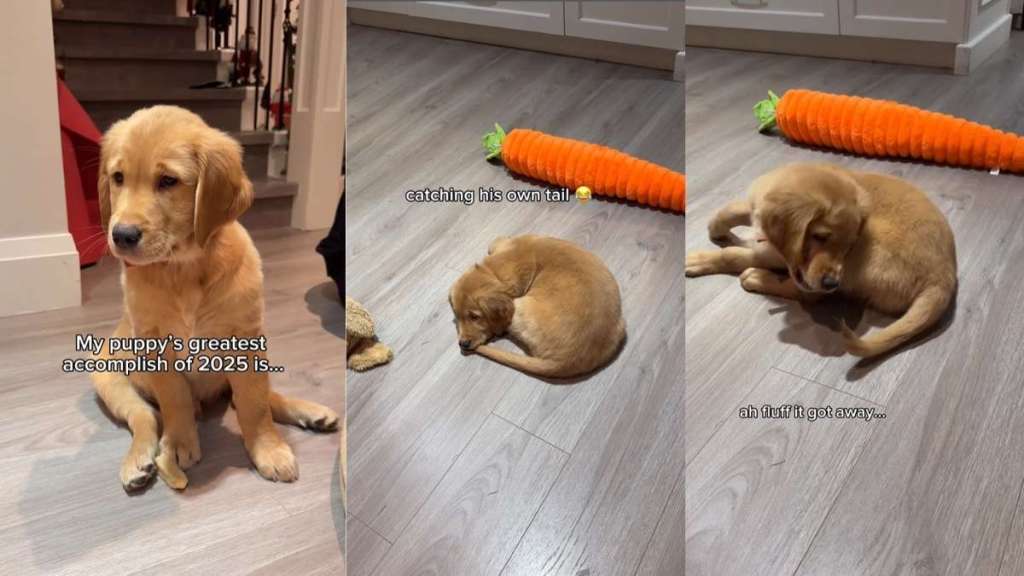
A Golden Retriever puppy’s so-called “greatest accomplishment of 2025” has been amusing viewers after a video of the moment was shared by his owner on @goldenmase. The clip opens with on-screen text that reads, “My puppy’s greatest accomplishment of 2025 is…,” setting up what quickly becomes a comical scene. Moments later, the camera cuts to the young dog focused intensely on his own tail.
The puppy can be seen spinning in circles, clearly determined to grab the wagging tail with his mouth. Each time he appears to succeed, the tail slips away almost instantly, prompting him to try again with renewed effort. His movements grow faster and more frantic as he continues chasing himself, unaware that the target he’s after is attached to him the entire time.
As the video progresses, the puppy’s energy begins to fade. After several failed attempts, he finally gives up and collapses onto the floor, visibly tired from the effort. In the caption, the owner jokingly refers to the moment as “puppy struggles.”
Tail chasing is a common behavior in puppies, especially during their early developmental stages. At that age, dogs are still learning about their bodies and the world around them. A moving tail can look like a fascinating toy, triggering a puppy’s instinct to chase and grab it. Puppies are also bursting with energy and curiosity, which makes repetitive behaviors like spinning or chasing more likely.
In most cases, tail chasing is harmless and simply a form of play or exploration. As dogs grow older and become more aware of their bodies, the behavior usually fades on its own. However, if tail chasing becomes obsessive or continues into adulthood, veterinarians often recommend monitoring it more closely.
Discover more from DogTime
Subscribe to get the latest posts sent to your email.