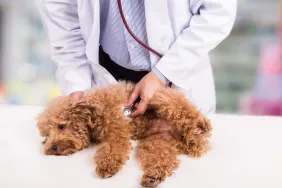
Meet the top five American dog breeds ... and nineteen of their diseases

Thursday March 31st, 2011

  • Share on Facebook
Column_mutt
When it comes to good health, are mutts better than purebreds?

This editorial courtesy of Dr. Patty Khuly, PetMD.com.

At the risk of sounding like one of those pure breed hating veterinarians who would like nothing better than to eliminate all purebreds on the basis of their genetic diseases (I've been accused of this many a time), I bring you this topic: five top dog breeds and nineteen of their most popular diseases.

It's a touchy subject, to be sure. Though it might seem like a no-brainer to attempt to showcase the most persistent dog diseases in our most popular dogs (after all, chances are you'll be meeting one of them sometime soon), people can get all touchy about their pets' genetics.

I guess this makes some sense. If you're a breeder who’s working hard to eliminate lymphoma in your line of Golden Retrievers, being reminded that your breed still has a long way to go kind of sucks. I get it. And if you're a Golden breeder who worries about any negative press for your breed, regardless of your attempts to remedy the situation via your breeding practices … well, then you'll be (noisily) unhappy, too.

But here's my take: Breeders need to be reminded that their breeds need work. Owners and prospective buyers/adopters need to know what they're in for so they can make the best healthcare/financial decisions for their pets. Makes sense, right?

Pet health insurance companies think so. They've been (responsibly) highlighting the diseases individual breeds are more susceptible to. Not only is this helpful when deciding on a breed, it also helps explain why pet care (and pet insurance, by extension) might be more expensive for some purebreds.

To that end, Embrace Pet Insurance developed a breed library and a genetic disease library to accompany it (full disclosure: I authored over a hundred of these genetic disease articles). The two groups of articles are meant to cross-reference one another so as to help owners of purebreds understand which diseases to look out for and how best to avoid them or manage them.

Trupanion, another pet health insurance company, has addressed the same issue in a recent press release intended to highlight the biggest, baddest problems afflicting our top-five breeds of dogs.

Curious? I was. And I don't think they'll mind if I steal their thunder:

1. Labrador retriever

  • Patellar luxation
  • Achondroplasia (a genetic disorder causing dwarfism)
  • Legg-Perthes (a degenerative disease of the hip joint)
  • Portacaval shunts (a serious liver condition)
  • Cherry Eye (a congenital eye defect)
  • Glaucoma
  • Epilepsy
  • Hip dysplasia

5. Golden retriever

Now, I'm not exactly sure how the people at Trupanion arrived at their stats, but these "breed warnings" seem fairly accurate. It's a great eye-opener for those who may not have guessed at their dog's genetic proclivities.

However, if I really wanted to know what I'm in for, breed-wise, I'd probably skip right on over to Embrace's less sexy but more scientific rendering of the subject. I know I'm kind of biased … but what can I say? I prefer a more complete approach to the subject of genetic diseases in pets. Does that make me a pure breed hater? I don't think so.

This article originally appeared here at PetMD.com.

More dog Content
  • March 31st, 2011

    Canine hip dysplasia is a genetic disorder in which a dog's ball-and-socket hip joint is poorly joined. This joint should fit neatly together in an arrangement that allows dogs to move their legs freely...

  • June 16th, 2009

    Due to poor breeding practices, some breeds are prone to certain genetic health problems, such as hip dysplasia. This doesn't mean that every dog of that breed will develop those diseases; it just...

  • Square_100_basset_hound

    March 31st, 2011

    This article courtesy of PetMD.com. Nothing is cuter in this world than a puppy, especially one from impeccable lineage. But as many a princess has learned throughout history, keeping it in the family...

No comments about this page yet. Be the first!

Recent conversations on these topics

  • K9 Advantix Side Effects?

    Today I used K9 Advantix topical flea prevention on my 40lb dog. After I put it on her, she began pacing around the house and has been completely uninterested in anybody all day, she just wants to curl up in any strange corner she can find. Why is she acting this way? Is she having an allergic reaction to this product? She acted a little strange last time but I didnt think anything of it, this time...i'm not so sure. Should I stop using this product? Any suggestions are appreciated, thanks.

  • Hacking

    5 days ago I was surprised with a 3 month old adorable female schnauzer. Everything is going great. I took her to her kennels vet for a 72hr. follow up check and was told evertything looked good. She was hacking a lttle when I first got her, and now seems to do it more. Nothing comes up. It hasn't affected her appetite, activity, although it wakes her sometimes. When I mentioned it to the vet, he said she was getting over a cold. Will this pass or should I be concerned? I don't see it getting any better (2 days)

  • Toe Pads "fused" - what to do?

    The two center toe pads on BOTH of our puppy's front feet are fused/connected. (she is a female Akita) There is no involvement of the bones of the toe - they are separate. Its just that the the pad on these two toes is connected. I'm not referring to "webbed feet" which I'm familiar with - the toe pads are actually connected. This is obviously a congenital issues and I've never seen anything like it before (and I've "Googled" ever imaginable search term for this and keep coming up empty). Has anyone seen this before? I'm wondering if we should just leave it "as is" or surgically correct the issue. She seems to manage fine with the issue however she does get a little sensitive when touching her feet / paws. Additionally, i've noticed that she does NOT like walking up steps which obviously puts pressure on her paw pads (and the center toes don't really separate which I imagine is uncomfortable since there is essentially no "give"). We just had her spayed and the vet mentioned that she hasn't really seen this issue before however it should (theoretically) be easily corrected by simply surgically cutting/tearing the skin between the fused pads which would free them up and give her better range of motion, balance?, etc. Has anyone seen or experienced this? I'd be curious to hear from others since i'd like to make a determination now while she is still a puppy if we should just leave it as is OR have the issue corrected before she reaches full maturity (she's 6 months old now). Thoughts?

  • cushings disease

    My 12 year old dog was diagnosed with cushings disease. She is having trouble going up our wood stairs without sometimes slipping. What can I do?

AD
Dear-tabby-meow-mix-300x90

Welcome to DogTime.com

DOGTIME LOGIN or SIGN UP

AD
AD