Ad
Ad

Dog doesn't like crate

QUESTION:

What if I don't like putting my dog in a crate?

answered by Kelly Dunbar

ANSWER:

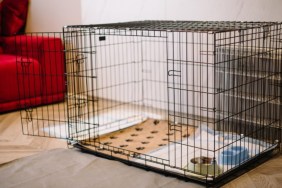
Crate confinement is a temporary training measure and it's the best way to teach your dog three-step housetraining, where to eliminate, and what to chew. Once your pup has learned those lessons he may be given free run of the house and garden for the rest of his life.

If, on the other hand, your untrained dog or puppy is given unsupervised free run of the house from the outset, the odds are that he'll be confined later on--first to the yard, then to the basement, then to a cage in an animal shelter, and then to a coffin. Without a doubt, housesoiling and destructive chewing are the two most common terminal illnesses in dogs. Using a dog crate will help you solve these problems or prevent them from ever developing.

However, if you absolutely can't stand the idea of keeping your dog confined, there's an alternative. You can keep the dog on a short leash, which you attach either to your belt or to an eye-hook that's screwed into the baseboard of your house. If you put eye-hooks in every room, you can take the pup with you as you move about the house. This way the dog is still restricted to small areas where he's unlikely to eliminate.

The rest of the technique is the same as for regular housetraining. Every 45 to 60 minutes, take the dog outside to the toilet area and reward him lavishly with praise and treats for using it. Once your pup is urine- and feces-free, you can give him about 10 or 15 minutes of off-leash supervised play and training time with you. What better reward for a successful elimination trip?



Kelly Dunbar is a cofounder and the executive editor of the dogstardaily.com and a contributing editor at DogTime.com. She is the president of Open Paw, a non-profit organization devoted to addressing the problem of unwanted animals in a whole new way.


Read more about Kelly Dunbar in the DogTime expert center...

Ad
Road to Rescue

Comments

Kdune_556k_thumbnailCongratulations on your new pup. I am not a vet, and do believe you should go see one. It is a good idea to establish a relationship with your local vet as soon as you get your dog.

The soft spot, might be what is called a molera, which is common in Chihuahuas and may take up to six-months to close.

If he has a big pot belly he is probably infested with round worms as well. Not uncommon, but it does need to be addressed.

My advice is to make an appointment with a vet to get a general health check and start your pup off on the right paw!” — Kelly Dunbar, May 19 2008

AvatarI just came home with my new "Cha-Winner" dog. He was the runt, but appears very healthy and small.He looks mostly Chichuachua. My question is I just noticed he still has his soft spot on top his head. The breeder said he is 11 weeks old. At what age does the soft spot grow together in a dog? Do you think he is younger than 11 weeks old? He eats fine, but has a big pot belly like he's still nursing.” — Travelbugg, May 18 2008

Add a comment


newest topics:
Training
Subscribe to Training 185 topics, 730 posts
Button_topic_start topics replies views last post
training warning! Please read.

Hey guys, I know everyone has a different method for training, but i just found out some stuff that I wanted to share. Th... (continued)

3 1264 2 days ago by kalli
view
new dachsie puppy

hi, we recently got a dachsie puppy, she is 8 weeks and i am having a really hard time with her and leaving her alone. ... (continued)

0 55 Nov 5, 2009 2:16pm by lost fish
view
re-potty trainning

We have a 2 years old shitzu, she was potty trained, but now for the last month or so every time when we came back home from work she has poop around the house. How should I re-training her???

4 342 Oct 31, 2009 9:39pm by dave
view
Very Sad:(

My dog is 4 years old and from the moment I got him he was an indoor dog.We just recently moved into a new home and my h... (continued)

1 385 Oct 19, 2009 3:57pm by Pup-Eez
view
Welcome! | 11/07/09
Please Login or Sign up
Ad
dog photos